


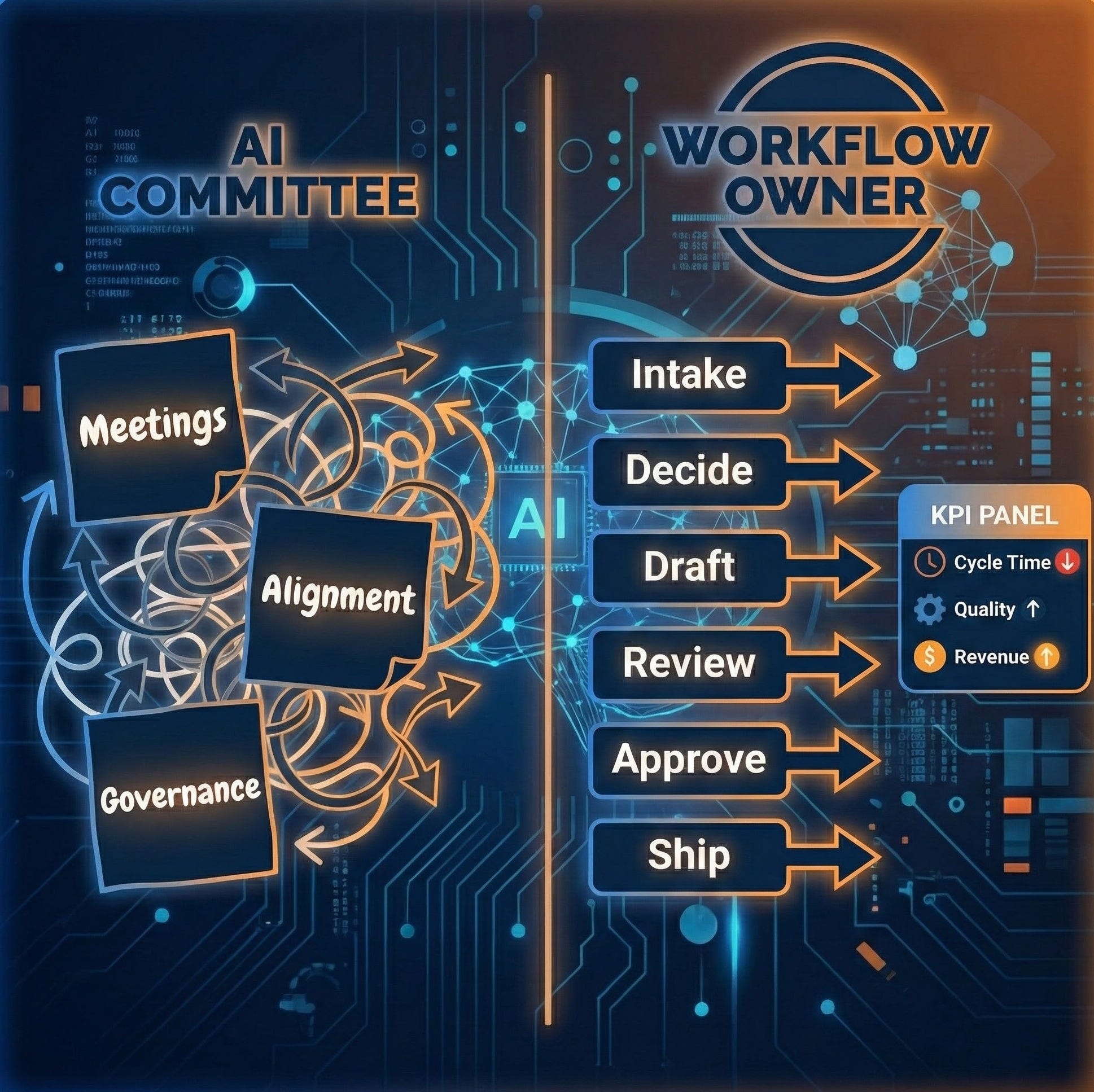
If you walk into any mid-to-large organization today, you will likely find an “AI Committee.”
They meet bi-weekly. The room is filled with department heads. They discuss governance, security compliance, and enterprise licensing. They leave the room feeling like they have “tackled AI.”
But if you look at the P&L a year later, the efficiency gains are negligible.
Here is my prediction for 2026: The centralized AI Committee, as the driver of innovation, will die out. It will be replaced by a decentralized, boots-on-the-ground network of Workflow Owners.
Why? Because most AI committees are built for the wrong reasons, populated by the wrong people, and tasked with the wrong outcomes.
Sales Team Example
The fatal flaw of the current AI Committee model is the gap between representation and reality.
Let’s say your committee has one representative from Sales. The “AI Sales Guru.” That person might be a VP or a Director. They understand strategy, but do they actually know how a Business Development Rep (BDR) constructs an outreach email at 8:15 AM? Do they know precisely how an Account Manager prepares for a renewal call using AI?
Likely not.
The “Sales Guru” is making decisions on tools and policies, but they are detached from the granular reality of execution. They cannot unlock efficiency because they are too far removed from the friction.
The unlock isn’t buying a tool for the department; it is mapping every specific workflow that team members use, understanding the nuance, and applying AI to the bottlenecks. You can’t do that from a boardroom. You can only do that from the desk.
The Core Problem: Automating Chaos
The reason most AI projects are currently abandoned is simple: Companies are trying to automate chaos.
We have fallen in love with the “magic” of AI and the output produced. We have ignored the “boring” mechanics of the process.
Here is the hard truth: When you apply AI to a broken, undefined process, you don’t get efficiency. You just get automated chaos at a higher speed.
To get the ROI promised by AI, you have to stop looking at the monitor and start looking at a whiteboard. You need to reverse engineer the outcome. This requires a skill that most modern knowledge workers have never truly practiced: Process Mapping.
You have to ask:
What is the trigger for this task?
What is the manual friction point?
Where does the data come from?
What does “done” look like?
Only once the chaos is organized into a map can AI be applied effectively.
The Shift: From Committees to Workflow Owners
In 2026, the winning organizations will be those that empower Workflow Owners.
A Workflow Owner isn’t necessarily a manager. They are the person who owns the task. They are the BDR who figured out how to scrape lead data and format it. They are the Recruiter who built a workflow to parse resumes against job descriptions.
Instead of one person representing “Sales” in a committee, you might have five Workflow Owners in Sales laddering up prescriptive intelligence:
Owner 1: Outbound Prospecting Workflow
Owner 2: CRM Data Hygiene Workflow
Owner 3: RFP Response Workflow
These owners don’t just ask “What tool should we buy?” They ask, “How do we shave 40 minutes off this specific task?”
How to Make the Transition (A Practical Guide)
If you want to beat the curve and stop wasting time in committee meetings, here is how you shift to a Workflow Owner model:
1. Keep the Committee for “Defense” Only Don’t fire the committee yet, but change their scope. The committee handles security, data privacy, and legal compliance (Defense). They are no longer responsible for “innovation” or “efficiency” (Offense).
2. Identify the “Critical Three” Don’t try to map the whole company at once. Pick three department-specific workflows where you suspect high friction exists.
Example: The creation of monthly marketing reports.
Example: The initial triage of customer support tickets.
Example: The drafting of sales follow-up emails.
3. The Whiteboard Session Get the actual people who do the work (the potential Workflow Owners) in a room. Do not open a laptop. Draw the process on a whiteboard.
Step 1 through Step 10.
Circle the steps that are repetitive, data-heavy, or require summarization.
This is where you apply the AI.
4. Document and Measure the Delta Have the Workflow Owner document the new AI-assisted process. Then, measure the gain.
Pre-AI: Task took 45 minutes.
Post-AI: Task takes 12 minutes.
Result: 33 minutes saved per rep, per day.
The Bottom Line
The tools are just the vehicle; the workflow is the map.
We are entering a moment where generalist “AI strategy” matters less than specific “operational excellence.” The companies that win in 2026 won’t be the ones with the most expensive software stack. They will be the ones that had the discipline to step away from the screen, map their chaos, and empower the people doing the work to fix it.
Need help getting started? We already have your playbook built. Get in touch to learn how PerformanceLabs can accelerate your AI ROI.