



I grew up at a time when nobody talked about how their brain worked.
I am Gen X. Mental health was not a conversation. You did not get a diagnosis, you got a report card, and mine was not good. School and I never got along. I could not hold sustained focus in a classroom if my life depended on it.
Once removed from a structured environment, I was a completely different person.
I took computers apart. I fixed bikes. I fixed cars. I tinkered in the woodshop.
Anything that let me figure out how a thing actually worked had my entire attention, for hours, without effort.
Nobody called it ADHD back then. They called it not applying yourself.
That pattern followed me into my career. I have never stayed at a company longer than five years. The one place I lasted the longest, I held four different roles while climbing the ranks. New challenges to solve, new teams to connect with, new systems to operationalize. The moment the puzzle was solved, I needed a different puzzle.
For most of my career, I treated that as something to manage. A flaw to work around.
Then the world sped up
Now, in the age of AI, my brain is finally in a perpetual state of change, and it is the best feeling I have ever had at work.
New models. New tools. New solutions. Building every single day. Solving problems in an afternoon that used to take a quarter.
My wife tells me I work too hard and too many hours. She is not wrong about the hours. But it doesn’t feel like work. There are days that end at midnight and feel like I put in half a day, because the whole thing flew by and I was having a blast.
I want to be honest about the other side of that, though.
Keeping up with AI is getting harder, not easier. New tools, new models, new everything. I am immersed in this seven days a week and there are still stretches where I feel behind.
Here is the real problem: there is no traditional learning track for any of this.
Sure, there are excellent MIT courses. The frontier labs offer genuinely solid material. I took the time to complete the full Anthropic certification series, and I would recommend it to anyone.
But, none of it teaches you what is going to happen next week. None of it shows you how to connect all the pieces. Taking an AI course today feels more like a history lesson.
So how is anyone supposed to keep up?
Here’s my routine
I build something every single day
Reading about AI is not learning AI.
You cannot absorb this stuff by simply reading about AI or watching a few TikTok videos. The gap between watching and shipping is enormous, and the only way across it is to open the laptop and get your hands dirty. Practical application is the only way to stay ahead.
So I build daily. Could be a personal app, a new client feature, or new automated workflow. Or an agent focused on one job that makes my life easier and increases my delivery velocity. It’s important to point out that I don’t just build and ship, I scour the README and technical documentation to deeply understand how it works and why.
I lean hard on an AI brain trust
This is the piece people underestimate. There is no better way to learn than by watching how others work, how they build, and the tools they use.
I do this with a small group of extremely smart builders that I talk with constantly. Not a mastermind, not a paid community. Just a handful of people who are elbow deep in the same work and who will tell me the truth about what is actually working.
What used to take me a week of research is now a message and a twenty minute reply from someone who already hit that wall.
The only rule I hold myself to is that I give more than I take. Everything I figure out goes back into the group. That is the whole reason it works.
I learn voraciously, but I filter ruthlessly
The volume is not the hard part. Choosing is the hard part.
I run everything I read through one question: does this change what I ship this week, and will it provide value when completed?
If yes, I go deep immediately and start building. If no, it goes in the mental parking lot. Most ideas get parked there, but they always seem to re-surface in a future application. Nobody is graded on their AI news comprehension.
Where this actually pays off
Here is the thing that makes any of it worth doing.
The models are not the value. The operational application is the value.
When I am embedded with a client, the insights that matter are almost never technical. They are the small ugly realities of how work actually gets done. The exception an executive makes for one account. The spreadsheet that quietly holds the whole process together. The handoff where things always go sideways.
That is the raw material. And because I am building every day, I can take something I learned in a side project on Tuesday night and have it running inside a client’s operation by Thursday.
The distance between “I saw a cool demo” and “this runs our Monday morning” is the entire job.
That is the part almost nobody is teaching.
The part I deeply care about
I want to be careful here, because I know how this reads.
My brain runs on novelty and change. This particular moment in technology happens to be perfectly shaped for the way I am wired. That is luck, not virtue.
For most people, this pace is not energizing. It is exhausting. The tools change faster than anyone can build a workflow around them, and there is no course that ends with you knowing what you need to know.
That is not a character flaw. That is the more reasonable reaction.
Which is exactly why I love sharing this stuff. I get to be the person who is genuinely having fun in the chaos, and the least I can do is hand people the map so they do not have to spend seven days a week in it.
Come hang out with us
That is really the reason we built The Operator’s Hour.
It’s a monthly hour I host with fellow builder, Eric Lovold, and the premise is simple. Eric and I have these conversations all day long anyway, so we are just doing them in public.
What it is not: a webinar with a deck. There is no deck. Ever.
What it is: what actually changed in AI over the last month, a real conversation about one topic, and then we open the laptop and build something live. Mistakes included. We leave those in on purpose, because that is where the useful stuff is. The chat drives half the hour, and we close by naming one thing you can actually go do on Monday.
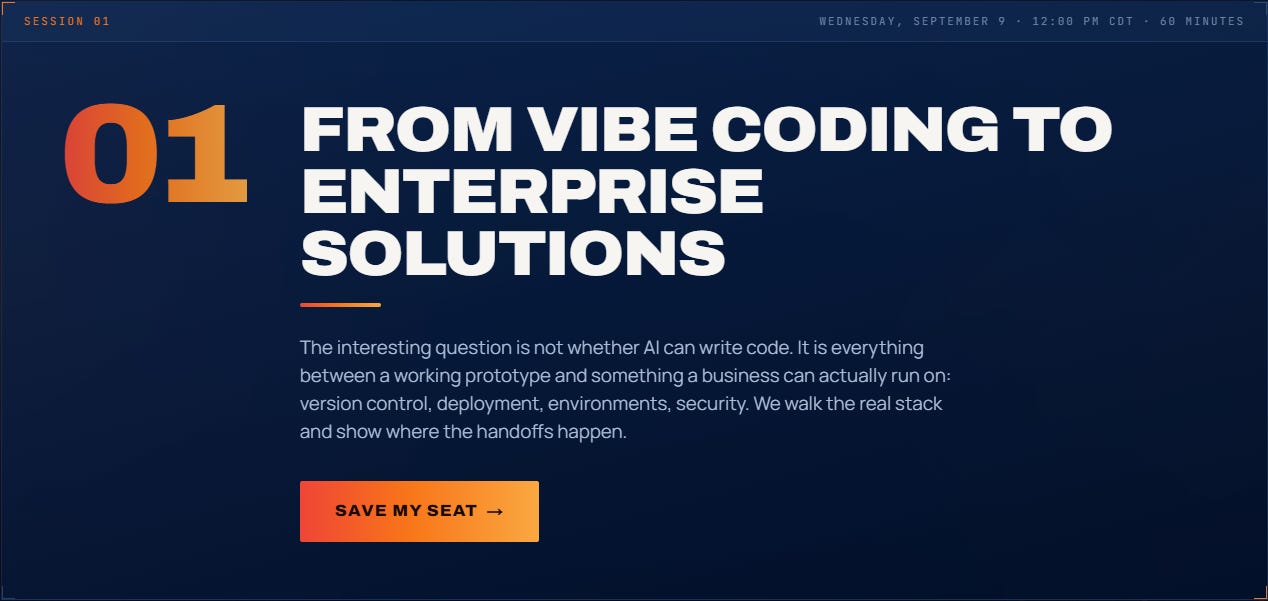
We’re kicking things off on September 9th, and we are starting with the jump from vibe coding to building enterprise solutions. The tool stack, and specifically the handoff points where most people fall off.
There is no pitch. There is nothing to buy. Hell, we won’t even be mad if you stalk the meeting with your camera and mic off. What matters most to us is that you walk away with something you can apply immediately.
If you have been trying to keep up and it has been wearing you out, come sit in the room with us for an hour.
And if you have your own routine for staying current, reply and tell me. I’ll steal the good bits and give you credit when I do.