

Last weekend, we had dinner with friends we’ve known for years. The kind of friends where one sentence can surface a dozen old references and the whole table laughs before anyone explains why.
This time was different. A new couple joined us. Everyone at the table had met them except one, and the dynamic shifted immediately. The shorthand stopped working. Every reference needed a backstory. Every joke needed setup. We slowed down and started telling the full versions of stories we usually compress into a sentence.
Somewhere between the third explained reference and the fourth, I caught myself watching the room differently.
We were building context in real time.
Loading memory into the new couple so that next dinner, they’d be in rhythm with us. They’d catch the reference before the punchline.
I do that every day with AI.
That was the moment I realized eighteen months of deep AI immersion has changed how I think.
Context and memory are what make AI feel human. They’re also what make humans feel known to each other. I work across more than fifteen AI tools every day. Enough that the rhythm of it has become normal. The work is real. The output is real. But the part nobody warned me about is what happens to your brain when you spend that much time in a medium with limited or pre-configured memory. Every conversation starts close to zero. You build the context yourself, every time.
And that’s before the switching starts.
In a single hour I might move from coding to design review to drafting client copy to mapping a workflow. Each mode asks a different version of my brain to show up. Different vocabulary. Different pace. Different posture. After eighteen months of doing that all day, every day, my brain feels more elastic. Faster to load a new frame. Quicker to drop the old one.
I notice the tradeoff most when I try to do something that requires sustained, single-mode focus. That muscle feels different now too.
A shift in cognition
Recently, I realized that my dreams have changed. That’s where I notice it most clearly. They’re more abstract than they used to be, but also more problem-solving. More about pulling pieces together. It feels like my brain is reorganizing something overnight to match the way I spend my waking hours. Not unsettling. Just new.
When I’m with people, I notice more. Body language. Micro-expressions. Tone shifts. The pause before someone answers a question.
I think that’s because I spend so much of my day working in a medium that strips most of that away and is quick to answer. So when the full bandwidth of human communication is back in front of me, I’m tuned to it differently. More attentive. Maybe more grateful for it.
I want to be honest about something: eighteen months in, my brain chemistry feels different.
I can’t fully explain that. I don’t know where it lands long term. I don’t see it as negative. I’m simply reporting from inside the experiment, an not selling the outcome. But right now, in this moment, the shift has been a net positive. I’m more thoughtful. More present. More aware of my own patterns. The work hasn’t hollowed me out. If anything, it’s done the opposite.
The unexpected physical turn
Here’s the part I didn’t expect.
The deeper I’ve gone into AI, the more I’ve ended up using my hands, and not the keyboard an mouse variety.
This past winter I took on a massive yard project: a stand of dead trees that needed to come down. Before I made a single cut, I was photographing each tree from multiple angles and walking through the job with AI. What’s the best sequence of cuts given the lean? Where are the pressure points where the saw could bind? What’s the safest fall path? I was running simulations from real photographs of real trees, working through the physics before I ever pulled the cord.
And that mattered, because the physics of a leaning tree is not something you want to learn the hard way. A bound saw is a bad day. A misjudged fall is worse.
That project led me to a new chainsaw, which I researched with AI helping me think through the purchase. Then I needed to keep it sharp, so I learned how to sharpen the chain properly. The trees came down. Then came the splitting, which sent me down another path entirely.
Splitting axes. Mauls. Wedges. The differences between them. Which tool for which job.
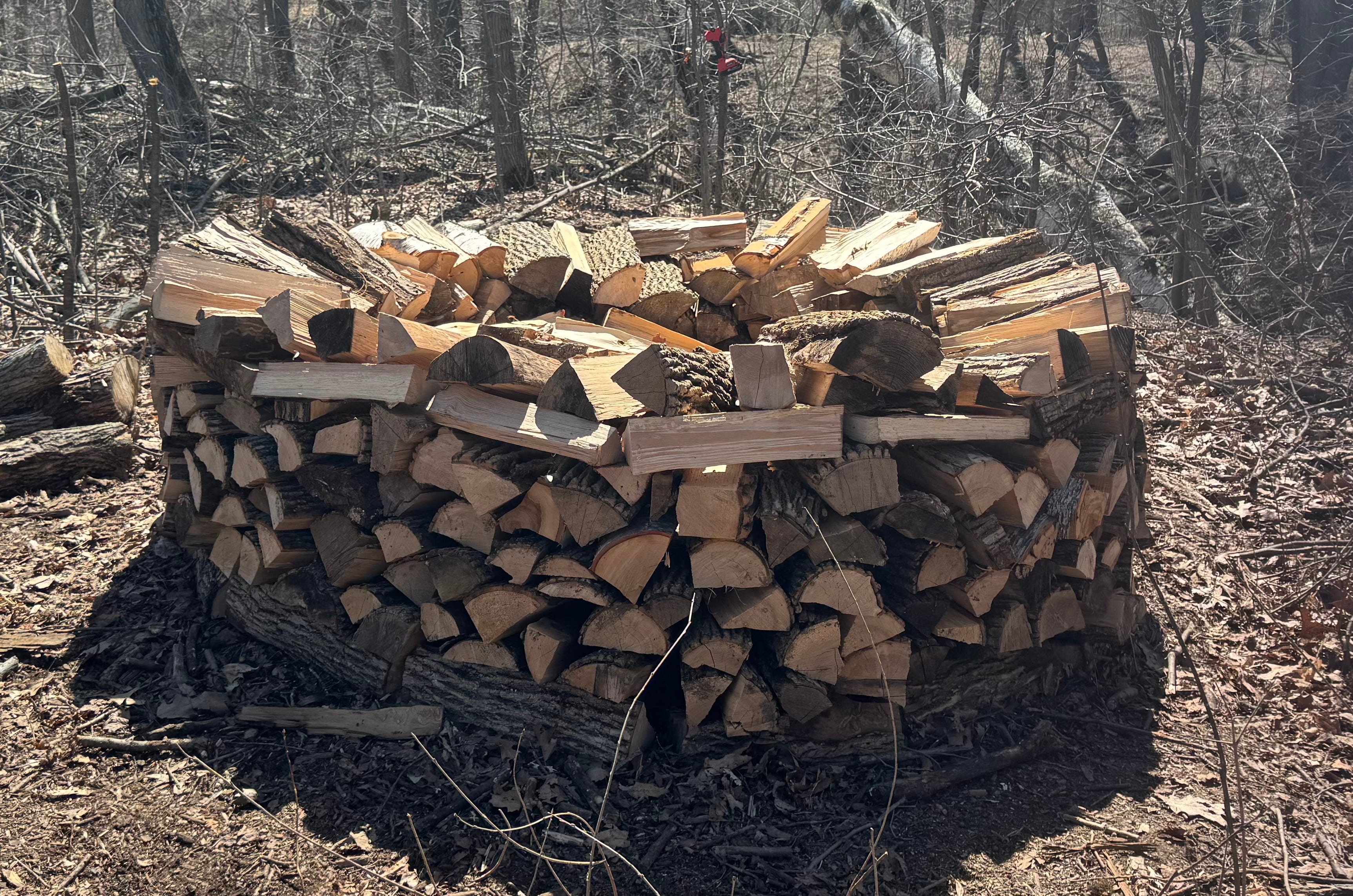
I landed on a setup that worked, then learned how to keep a proper edge with a whetstone. Sharpening an axe by hand is its own quiet skill. Once I had a yard full of split rounds, the question became how to stack it. That’s how I ended up learning to build a Holshausen, the German wood-stacking technique where you build a round, self-supporting tower of split logs that sheds water and seasons faster than a traditional row stack.
Why grounding matters
Two years ago, I would have called a tree service and written a check.
Now I’m interested in the process. The physics. The technique. The craft of it.
AI didn’t just help me get the job done. It made me curious about the job in the first place.
That’s the pattern I keep noticing. AI has opened me up to new experiences I wouldn’t have pursued, skills I wouldn’t have learned, and curiosities I wouldn’t have indulged. The tool that lives entirely in language and screens has somehow pushed me further into the physical world. And made me more careful in it.
What’s kept me grounded is the off-ramp.
I unplug on purpose now. I know when I need to. Nature does the work. Exercise outdoors does the work. The feeling of accomplishment hits when my brain finally stops indexing and I'm just swinging the maul. That does the work too.
That reflection is what makes the immersion sustainable. Without it, I think eighteen months of this would have broken something. With it, the opposite has happened. I’m more myself, not less.
The larger question
Next time we have dinner with that group, the new couple will be in tow. The shorthand will return. The references will land. Context and memory will have done their quiet work, the way they always do between people who keep showing up for each other.
That’s how humans build connection. It’s also what we’re teaching AI to do.
The interesting question isn’t whether AI is becoming more human. It’s whether spending this much time with AI is making us pay closer attention to what being human actually requires.
I don’t have the answer.
But I know what I’m learning about myself.
And, should AI take all of our jobs, you have a solid career in firewood sales waiting for you!
"AI didn’t just help me get the job done. It made me curious about the job in the first place".
This part really got me. There’s this common fear that AI will strip away curiosity because it can do so much of the work for us, but I’ve often found the opposite. I guess it really depends on how we use it. It was a good read, Tony!