


There’s a moment in every sales leader’s career when they realize the system they’ve been trusting is only telling them part of the story.
For most, that moment never comes. They keep running pipeline reviews off the same CRM dashboards. They keep building forecasts from the same filtered views. They keep making million-dollar decisions based on data that is incomplete at best and actively misleading at worst.
I know because I spent 25 years living inside that problem. I started carrying a bag in media sales, worked my way into leadership, and eventually landed in the executive RevOps seat where forecasts, pipeline strategy, and resource allocation all converge. I sat in the pipeline reviews at every level. I watched decisions get made based on numbers that I knew, from hard experience, didn’t reflect reality.
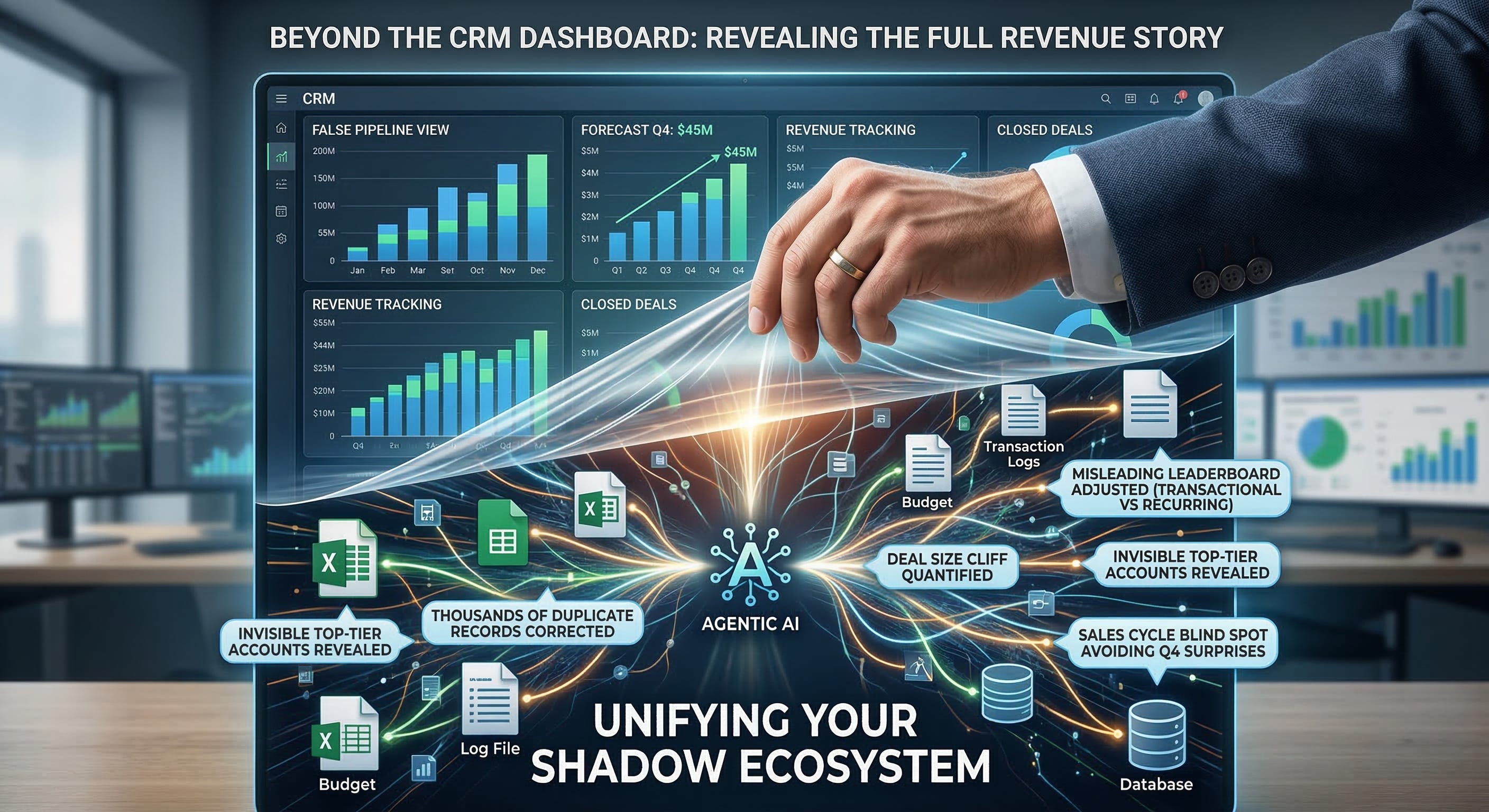
That experience is exactly why we engineered an agentic revenue intelligence system that connects every data source a sales org touches, not just the CRM.

What Happens When You Connect Everything
We recently kicked off an engagement with an established B2B company with nine figures in annual revenue. Strong top-line revenue. A tenured sales team. A CRM with years of deal history. And alongside it, a shadow ecosystem of spreadsheets, budget files, and transactional logs that various people across the org had been maintaining independently.
None of these data sources had ever been analyzed together.
We connected their CRM to our intelligence system. Then we ingested every spreadsheet, export, and file their team had been working from in isolation. Every source was vectorized into a unified, queryable format. Every data environment was containerized for security and isolation. No duct tape integrations. No “throw it in a data lake and hope.”
Two weeks later, the picture that emerged was one their leadership team had never seen.
What the Data Revealed
Thousands of duplicate records. Years of data entry across multiple reps and systems without deduplication had inflated contact counts and muddied every report generated from the CRM. Nobody knew until a system was smart enough to look.
Top-tier customers hiding in plain sight. Several high-revenue accounts had zero logged engagement in the CRM. The people managing those relationships never used the system to track them. When a senior account manager leaves, all of that institutional knowledge walks out the door. These accounts weren’t lost. They were invisible. And in a system that only sees what’s logged, invisible is the same as nonexistent.
A performance leaderboard built on a mirage. One rep appeared to have the highest win rate on the team. In reality, it was a function of transactional deals that are entered as they come in and marked C/W right after. Without separating recurring pipeline from transactional revenue, leadership was coaching off of an incomplete view of the data.
A deal size cliff nobody had quantified. Smaller opportunities were closing at materially higher rates than larger ones. The gap was significant enough to change how you staff, forecast, and allocate resources. The sales leader had sensed this for years. He had never seen it isolated as a metric he could act on.
A cycle length blind spot wrecking the forecast. One of their strongest segments had a sales cycle long enough that deals started in the back half of the year were unlikely to close before fiscal year-end. That single insight reshapes how you plan headcount, marketing spend, and prospecting cadence for the following year.
A formatting issue corrupting the foundation. Inconsistencies in deal stage labels were causing the CRM to treat identical outcomes as separate categories. A portion of closed deals were falling through the cracks of every automated report the team had ever run. Nobody caught it because nobody had a system auditing at that level.
None of this was new data. It was already there. It just needed to be connected, cleaned, and queried at scale.
Why No SaaS Platform Can Do This
Every insight above came from data the client already owned, spread across multiple systems.
This is the fundamental limitation of every CRM analytics tool and BI dashboard on the market. They analyze what’s inside their own walls. Connect your CRM and you get CRM insights. But the budget file your finance team updates quarterly? The transactional log in a shared drive? The spreadsheet your Sales leader maintains on the side? None of that makes it into the picture.
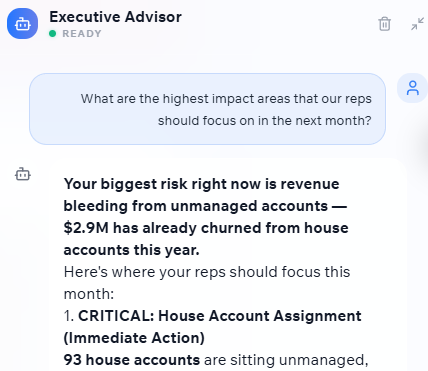
Our approach is architecturally different. We pull from every system, every format, every silo. Vectorization makes it queryable. Containerization keeps it secure. Agentic AI asks every question a human would think to ask, plus the thousands they wouldn’t.
That is how invisible accounts become visible. How misleading metrics get corrected. How a six-month sales cycle stops being a surprise in Q4.
The Compounding Gap
The revenue leaders connecting AI to their full data picture are pulling away. Better bets. Precision coaching. Faster kills on bad deals. And every quarter of data they feed the system, the forecasts get tighter and the segmentation gets richer.
The ones relying on one SaaS tool’s view of the world are making decisions with less than half the picture. The ones who think a new SaaS AI feature they bought will somehow change the game.
Three questions every CRO should be able to answer from their own data today:
How many of your current open opportunities share the exact loss pattern of deals you’ve already lost this year?
How much revenue lives entirely in someone’s head and has never been logged in your CRM?
When was the last time anyone verified that your CRM’s reporting categories actually match what your team is entering?
If you can’t answer those at the press of a button, your data is a filing cabinet. Not an intelligence system.
That's exactly what our forward-deployed revenue intelligence engagements are designed to solve. Two weeks, your existing data, no rip-and-replace. Just the picture your CRM was never designed to show you.